 Shih Tzu
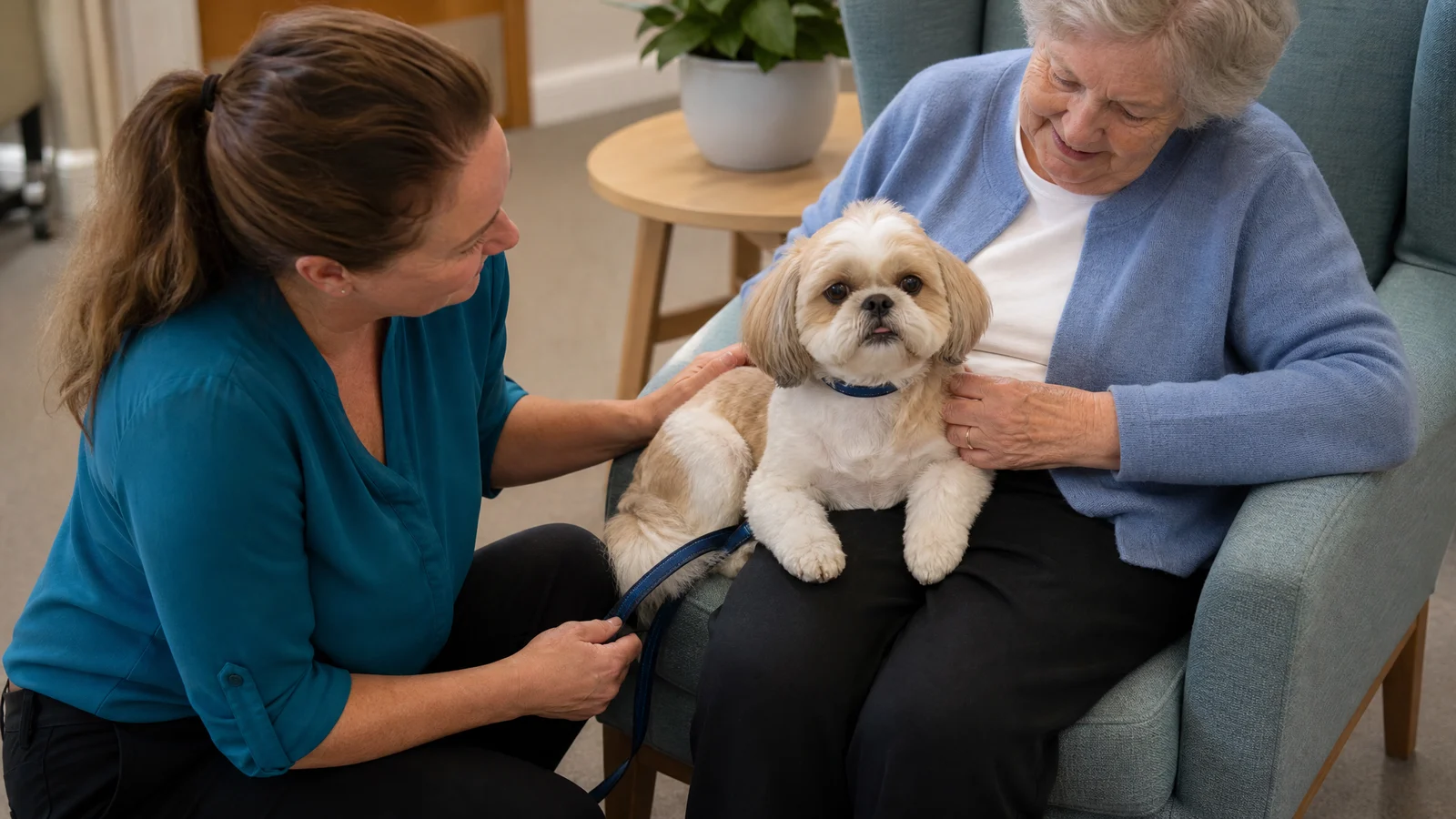
Check each group's requirements, including any minimum age, but the real question is what happens between puppyhood and the evaluation. A puppy who charms every guest in the living room still has to grow into a dog who stays steady when a stranger leans over, a walker clanks through a doorway, or a tray rattles down a hallway.
That waiting period is the most useful stretch you will have, because it decides whether your dog enjoys visiting or only puts up with it. Rushed, you get a worried dog on a hospital floor. Done patiently, you get a dog who hands comfort back, which is the job the breed has filled for centuries as canine comforters. We have trained this breed for many years and know how much the first year matters.
In this article, we'll go through whether your own dog suits the work, how service, therapy and support roles differ, and the steps of obedience, the Canine Good Citizen test and choosing a certifying group, ending with a plan for your first two weeks.
Shih Tzu Service Dog Suitability
Sit in a busy waiting room and watch what happens when a stranger reaches toward a Shih Tzu. Some lean into the hand and ask for more, while others stiffen, glance up at their person, and ease behind an ankle. That half second tells you more than any pedigree, because the breed's history as royal lap companions is background and not proof about the dog beside you.
The test is simple to state. Before preparing for therapy work, ask whether your dog is obedient and well trained, yes, but also calm, happy to interact with people, and able to put up with occasional physical discomfort and mental stress. Obedience can be taught. The temperament underneath has to be largely there already, and the breed standard asks for an outgoing, friendly dog who trusts everyone.
Individual Differences
Dogs of one breed can be strikingly unlike each other. We reviewed 1,152 Shih Tzu owners' first-hand accounts, and the therapy-dog teams among them sit beside many households where two Shih Tzu are near opposites, one quick and eager and the other unable to hold a sit-stay. Some puppies are too excitable for training at first, and owners describe them settling with time. Our guide to Shih Tzu temperament explains what to expect as that happens.
Honest Questions to Ask
Put your own dog through these before spending money on classes:
- Does your dog approach new people with a loose, wiggly body and recover quickly from a sudden noise?
- Can your dog be handled all over, including paws, ears and coat, without pulling away or going rigid?
- Does your dog still seek out people at the end of a busy outing, or shut down and look for the exit?
- Does your dog stay relaxed around other animals at a distance?
A dog who does not start to recover from a scare after a few good experiences needs a slower plan, not more exposure. If most answers are yes, carry on and book a regular vet visit to settle the question of health. If your dog is anxious, being a happy home companion is a fine career, and far kinder than a visiting schedule they dread.
Your veterinarian is the right person to say whether your dog's health, vaccinations and age suit regular visits to care facilities, so raise it at the next checkup. Everything here is general information for owners.
Service Dog, Therapy or Support Roles
A Shih Tzu curled in a lap in a quiet room is doing something worthwhile, but what that something is depends on who the dog works for and what training stands behind it. People blur these three roles constantly, and choosing the wrong goal can waste months of effort.

Service animals, as defined by the AVMA, are dogs who assist a person with a disability and are individually trained to perform specific tasks. That is task training built around one person's needs, and we won't guess at which tasks suit a small dog. Therapy work is different. PetMD explains that therapy dogs need a pleasant temperament and friendliness with strangers, and most must pass an exam from the certifying body or the Canine Good Citizen test.
This table lines the three roles up by who benefits and what the training involves.
| Role | Who the dog helps | Training focus |
|---|---|---|
| Service dog | One person with a disability | Individual task training for that person |
| Therapy dog | Many people, with the handler present | Obedience, calm temperament, an evaluation |
| Emotional support | The owner, through companionship | Good everyday manners |
We make no legal claims here, and access rules vary by place and situation, so check official sources before relying on any role for housing, travel or public access. Emotional support is simply what a Shih Tzu already gives a person who loves them, and it grows from good manners and a close bond.
For most owners of this breed, the realistic route is therapy work or emotional support. A dog built to share affection with everyone suits those jobs better than one person's specialized tasks. So choose therapy if you want to share your dog with others, and emotional support if you want a polished companion at home.
Service Dog Obedience Comes First
Evaluators report that many people turn up with untrained or unreliable dogs, and a dog who performs a flawless sit at home in the kitchen can forget every cue in a room full of strangers. Basic obedience, taught at home or in a class, is the first step, and it comes before any paperwork or phone calls.
Cues Your Dog Needs
Build a dependable sit, down, stay, come when called, loose-leash walking and leave-it. Shih Tzu respond best to praise and rewards, and many owners find food is what makes training work, whether that is tiny pieces of chicken or egg, or peas, carrots and green beans, since some dogs only comply for something very tempting.
Keep sessions short and cheerful, because Shih Tzu don't respond well to harsh techniques, and less is more: it is easier to tone down an exuberant puppy later than to restore spark lost to overtraining. Sit on the floor or lift your dog onto a couch or platform, since small dogs dislike being loomed over.
Some owners find basic commands arrive slowly, so read why a clever Shih Tzu can still seem stubborn if you hit a wall, and see our complete training guide for the foundations.
Distraction and Calm Greetings
People are both the biggest reward and the biggest distraction for this breed, so a cue proven in your kitchen has to be proven again around friendly strangers. Ask a friend to approach while your dog sits, and reward only while all four paws stay on the floor. If your dog bounces, the friend turns away and the fun pauses, a mild consequence that works well on a dog who craves company.
Then raise the difficulty a notch at a time: a second person, a park bench, a dropped metal dish at a distance followed by a treat. Some owners report unreliable recall off leash, so build a habit you can trust, and our recall article shows how.
Here is the decision. Move on when your dog holds a sit-stay and a loose leash around friendly strangers in several different places. If they can't yet, wait and keep practicing.
Canine Good Citizen Test for Service Dogs
Evaluations commonly include handling by strangers, so rehearse it first. Passing this test before applying to become a therapy team is the recommended path, and it works as a dress rehearsal for everything that follows.
What Is Tested
The test covers 10 behaviors, the everyday manners of a dog you can take anywhere, and once your dog passes, the evaluator's paperwork goes in for the title. Read the current list on the official requirements page and rehearse each item, so nothing in the test is a surprise to you or to your dog.
How to Prepare
Practice in places that feel a little different each time, with a different helper each time, so your dog learns the exercise and not the room. The Shih Tzu coat invites hands, so brush daily, handle paws and ears, and reward calm acceptance, using a table or platform so no one has to hover over your dog.
The moment your dog shows stress, make the exercise easier, and end each session while your dog is still keen. Once every item works with someone your dog has never met, book the test.
Choosing a Service Dog Certifying Group
Therapy-dog organizations differ in their courses, evaluations and requirements, and a team that starts without checking can lose months. The sensible order is to learn what each certifier will require before you commit, using the national kennel registry's list of approved therapy-dog organizations rather than any single recommended name.
Cost and Requirements
We have no reliable fee figures to give you, so call or read each group's website and compare these points:
- Whether the course is online, in person or both, and whether you must pass a test before the evaluation.
- How the evaluation works, what it costs, and how often the team must renew.
- Any minimum age for the dog, and which health and vaccination records the group wants to see.
- How many visits are expected, since therapy titles follow visit counts, with the full Therapy Dog title needing 50 visits.
If you hire an instructor along the way, ask about methods and experience first, and choose someone who works with food and praise and who is happy to let you watch a class.
The Evaluation Itself
Certifier courses and evaluations may include walking through a large crowd, meeting groups of people, managing petting so the dog isn't overwhelmed, reactions to loud noises, grooming, and strangers touching the dog all over. Those are the skills to rehearse in advance, and a noise-sensitive dog needs gradual, treat-paired exposure well ahead of time.
Pick one group whose requirements you can meet comfortably and commit to it. Chasing several at once splits your attention and confuses your dog.
Therapy Visits With a Shih Tzu
A first visit rarely resembles a movie scene. Your dog will likely sit in a lap, be stroked by hands that may be unsteady, and be asked to stay calm while a child reads aloud or a tired nurse takes a break. Settings range from first graders reading to the dog, to stressed students, hospital staff, nursing homes and memory care.
The breed has a reputation for great therapy work, but small dogs tire. Many owners put a usual walk around 30 minutes, some dogs are finished after 10 or 20 minutes and need carrying, and a few are tired for days after one long outing. Plan short visits, give breaks, and let your dog show you when enough is enough. A Shih Tzu who prefers to watch from the sidelines may still be enjoying the company.
Handling needs care too. People unused to small dogs may squeeze or grab, so you manage the petting, keep your dog on a lap or raised platform, and tailor each visit to the person's wishes, since the handler needs excellent people skills.
Hygiene matters: brush and bathe beforehand and carry a towel. If your dog wears a mesh harness, check that it isn't matting the coat, and avoid hot rooms and hot parking lots, because the breed does not tolerate heat well.
Choose one setting that fits your dog's temperament, such as a reading program or a small care home, and begin with one visit at a time. Add more only when your dog still bounces to the door afterward, and keep up regular vet checks.
Your Shih Tzu's First Fortnight
You now know the road, so here is a plan for the next two weeks that gets you moving without overloading your dog. Keep every session short and cheerful, and finish each one with something your dog loves.
- Day 1: Write down the cues your dog knows well and the ones that fall apart around strangers.
- Day 2: Practice sit, down and stay at home with tiny treats and plenty of praise.
- Day 3: Visit your vet for a general checkup and mention that you are planning therapy work.
- Day 4: Practice handling on a table or platform: brushing, paws, ears and gentle touch all over, with a treat for calm.
- Day 5: Walk on a loose leash in a new, quiet place.
- Day 6: Rest day. Play, enjoy the zoomies, and skip the training.
- Day 7: Ask a friend to greet your dog, rewarding paws that stay on the floor.
- Day 8: Introduce noises at a distance, such as clapping or a dropped dish, paired with treats.
- Day 9: Visit a busier place in the cool part of the day and reward calm.
- Day 10: Look through the approved list of therapy organizations and choose one group.
- Day 11: Contact that group with questions about courses, evaluation, costs and age.
- Day 12: Practice a sit-stay with a stranger nearby and another dog at a distance.
- Day 13: Run through every Canine Good Citizen item and note what needs more work.
- Day 14: Rest, then pick a test date and write down your next steps.
The thread through all of it is the breed's own gift, because a Shih Tzu wants to be with people. Protect that by building skills gradually, rewarding generously, and letting your dog's enjoyment set the pace, so the work stays something they love doing.
 Training basicsShih Tzu Temperament and Personality: What It Means for Training
 Training basicsAre Shih Tzus Smart? Training Them With the Right Reward
 Puppy trainingHow to Care for a Shih Tzu Puppy: The First Week Home