 Shih Tzu
8 to 10 months is the age by which most Shih Tzu are completely reliable about potty habits, meaning they can be left unattended for many hours without an accident. That is longer than most new owners expect, and it is why breed writers call this little dog hard to housebreak. Knowing the number early turns a long run of slips into a plan with a finish line.
We'll walk you through a worked example, a puppy who comes home at ten weeks old and shares a two-bedroom apartment with you. We start with the setup and one full potty day, then cover the rewards, the accidents, and a month-by-month timeline. Handled well, this stage gives you a dog you can trust in every room. Handled badly, it teaches your dog that the whole home is a toilet.
Shih Tzu Potty Expectations
Start with the honest timeline, because it shapes every decision after it. Shih Tzu are often considered difficult to housebreak, and breed writers report that most are not completely reliable until about 8 to 10 months old. By reliable we mean a dog who can be left unattended for many hours with no accident.
Some dogs learn quickly and others take longer, and several weeks or even months to full reliability is normal. Many owners describe the same pattern: their dog learns walk or treat after a try or two, but needs many repetitions to link go potty with the right place. Some puppies are still soiling at 6 to 7 months, and the age of reliability varies widely, even between littermates.
A fair comparison is learning a language in a new country. Your puppy picks up treat at once because food explains itself, while a rule about where to potty is a rule about a place, and places take many repetitions to sink in. Owners often call the slowness stubbornness, and we would push back on that label.
A puppy who has been shown the right spot only a handful of times has not finished learning, so each slip tells you about your schedule, not your dog's character. We have trained this breed for many years, and the households that stay calm are the ones that planned for months from the first day. The puppy training timeline shows where potty work fits in the wider picture.
Our Apartment Potty Setup
To make the steps concrete, we'll follow a typical case from here on: a ten-week-old Shih Tzu puppy living in a two-bedroom apartment. Swap in your own layout as you read. Before the first trip, a few things need settling: where the puppy goes, what you keep on hand, and where the puppy is watched.
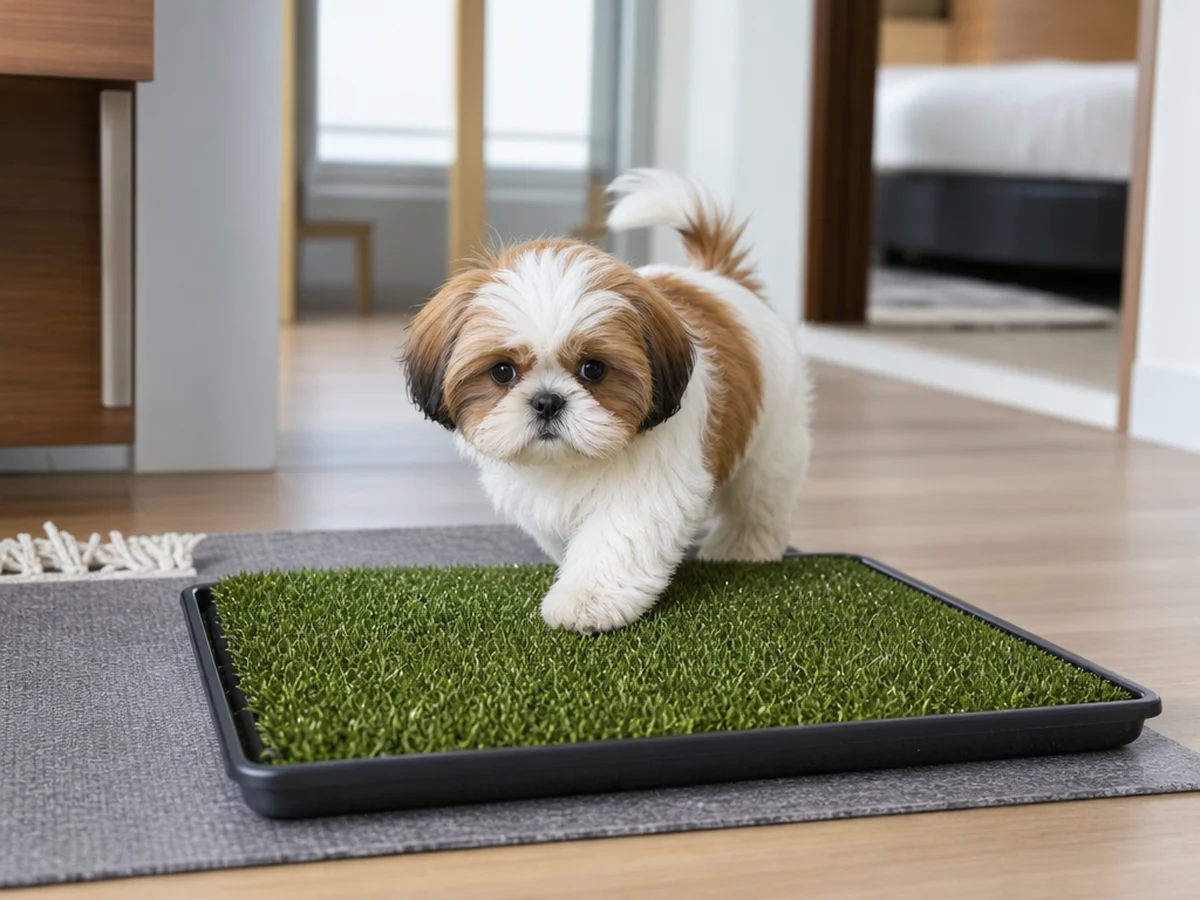
For the potty spot, choose one consistent outdoor spot and walk the puppy there on a leash every time. Our example owner picks the grass nearest the building door. Breed writers also describe Shih Tzu trained to paper or a covered litter box for life, which suits apartments, so the example adds a papered bathroom corner as a backup.
Pick one plan and keep it consistent. Owners are split on pads: some say a pad kept as an emergency backup helped, and some moved it step by step toward the door, while others skipped pads or found their dog came to dislike them. If you choose a litter pan, start with paper and gradually shrink the papered area.
The supervision zone is the living room, closed off with a gate, plus a crate beside the bed at night. Owners who succeed describe using a pen, crate, gated kitchen, or indoor leash, then opening the house room by room. Keep the bedrooms shut at first, because accidents often land on beds, couches, and pillows. The supplies are simple:
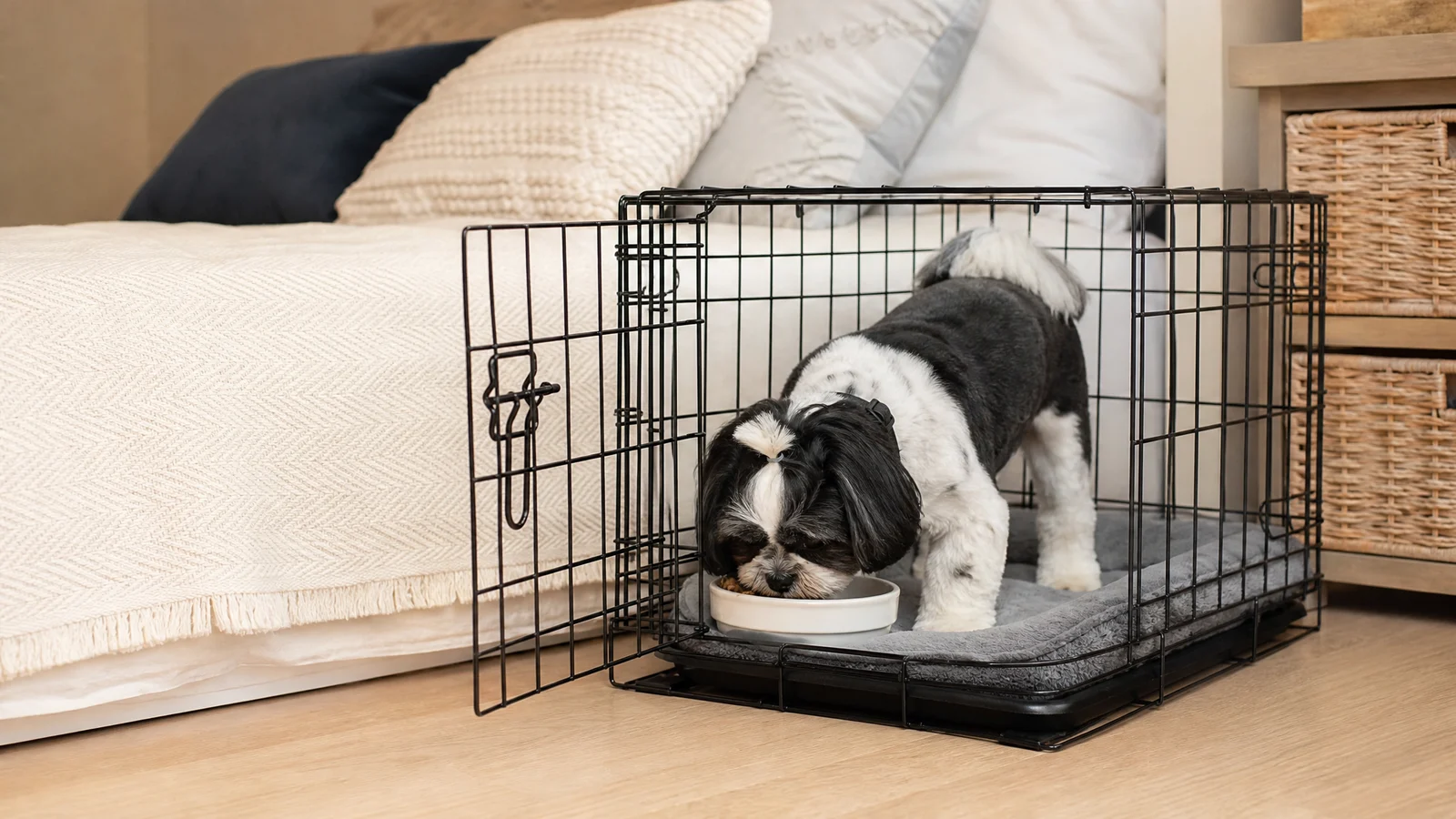
- A crate sized for the puppy, with a clip-on water bottle so the beard stays dry and the bowl cannot tip.
- A gate or pen that turns the living room into the supervision zone.
- A leash of 6 to 10 feet, for outdoor trips and for tethering the puppy to you indoors.
- A bell hung at dog level beside the door the puppy uses.
- A small jar of very good treats by that door, kept for potty success only.
A Shih Tzu Potty Day
A potty day runs on a clock and a set of events. For youngsters the clock means a trip about every two or three hours, and the events are on waking and after meals, after play, before and after crating, and before bed. Naps count as waking, so every time our example puppy opens their eyes, a trip follows.
Morning and After-Meal Trips
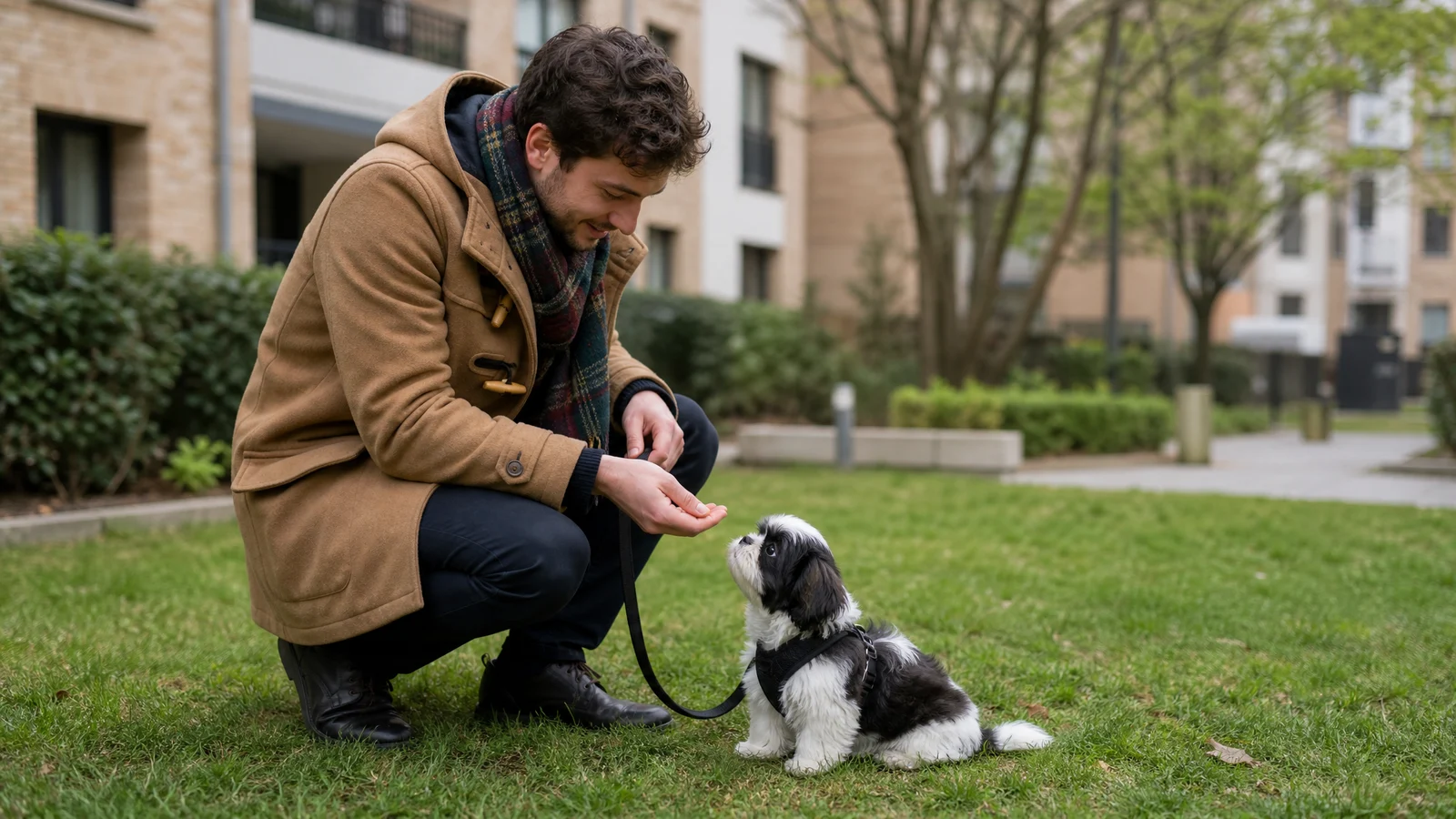
The day begins with a trip before anything else. The owner clips on the leash, walks the puppy to the same spot, and stands still, because going to the same area every time tells you when the puppy goes and lets you reward at once. Simply letting a puppy out into the yard hides the very moment you need to see, so we go out with them every time.
Breakfast is followed shortly by another trip, and the same repeats after each meal. Before heading out, the owner helps the puppy ring the bell with a paw or a nose bump. Dogs will not signal on their own, so the bell is something you teach. Some learn to ring it, others scratch the door, and a few never signal at all.
Supervised Play and Naps
After every play session the puppy goes out again. Between trips the owner tethers the puppy to themselves, which means clipping a 6 to 10 foot leash to your belt or chair, so the puppy has some freedom but stays in view. If the puppy starts to sniff around or circle, out they go.
Naps are crate time. Puppies are naturally clean and do not want to soil where they sleep, so the crate helps as long as the puppy has gone potty first and the crate is sized for them. If a puppy soils it anyway, the crate may be too big or the bedding too absorbent.
As a rule of thumb, puppies can hold it about one hour for every month of age, up to 8 hours, so a puppy this young gets short stints. Breed writers note that this companion breed does not fare well alone for long periods, so build time apart gradually and keep departures low-key.
Evening and Bedtime Trips
The last trip comes right before bed, after a quiet evening. Then the owner encourages the puppy into the crate with a treat, which works best when the crate is already the place where meals happen. The crate sits in the bedroom, so the puppy is safe but not lonely.
Many owners find the first nights hard, since young puppies often cry when left alone, and say the crying eased once the crate sat beside the bed. Open the crate only when the puppy is quiet, or crying becomes the key to the door. Our guide to the first nights at home covers that stretch in detail.
Shih Tzu Potty Rewards
Rewards tell your puppy which choice paid off, so timing and quality matter more than quantity. For the first few weeks, praise and treat outdoor toileting right away, because a treat even a minute later is too late. Our example owner keeps treats in a pocket and has one in hand before the puppy finishes.
Breed writers call for a really good, yummy treat every single time the dog goes outside, or a quick game for a ball-happy dog, with generous praise on top. Say your potty cue, the word you attach to the act, while the puppy is actually going. Later that cue lets you ask for a potty on request on a cold, rainy morning. Each trip runs the same way:
- Clip on the leash and go straight to the potty spot.
- Stand still and wait quietly.
- Say the cue as the puppy goes.
- Deliver the treat and praise within seconds, at the spot.
- Only then allow play or a walk.
Shih Tzu charm is part of the picture. Training works best when the puppy feels they are manipulating you into a reward, because then they perform eagerly, so ask for a little at a time and keep treats tiny. Breeders know how the story ends when charm wins: a chubby, not fully housebroken dog who wakes the owner at 5 a.m.
Fade slowly. Keep the treat every time while the habit is forming, then stretch the gaps between trips first, as owners do once their dog holds on longer, and thin the treats last. Praise and a quick game can carry a clean routine, while a treat returns for new places and after setbacks.
Potty Accidents and Setbacks
Our example puppy will slip, and that is expected on a timeline measured in months. Owners describe accidents landing on beds, couches, pillows, and even spots the dog had just been lying on, plus setbacks after progress, like peeing again minutes after coming inside. Each slip is information, so the plan is to respond calmly and tighten the routine.
Interrupting Calmly
If you catch the puppy mid-act, make a calm sound to pause them, then carry or lead them outside to the usual spot. When they finish there, reward them just as you would any success. A puddle you find later teaches nothing, so skip the drama and go straight to cleanup.
Cleaning Up
Clean the spot promptly and thoroughly with a cleaner made for pet messes, and wash any bedding that took the hit. Then ask what led up to it: how long since the last trip, whether it followed waking, a meal, or play, and whether the puppy was excited, scared, or somewhere new. Owners report accidents in exactly those situations, so they deserve an extra trip.
Tightening Supervision Afterward
After a slip, step back to the last level that worked: more frequent trips, the tether, the gated zone, and bedrooms closed again. Supervision should continue until the puppy has gone at least four to eight weeks without an indoor accident, so count from the last one. A pen alone is no cure, since some owners find even a small pen with a tray does not stop wrong-spot accidents.
Keep regular vet visits on the calendar at every age. A reliably trained adult who starts having accidents or going more often is a vet question first, not a retraining job, because frequent, painful, or difficult urination and urinating in odd places are signs of a bladder infection.
Potty Training Timeline by Month
Here is how the example puppy's progress might look from arrival to month ten. These are patterns owners describe, not promises, and dogs vary, even within one litter. The table charts the stages and what you do at each.
| Stage | What you may see | What you do |
|---|---|---|
| Week ten | Accidents are likely, and every minute is supervised | Prevent, supervise, reward every success |
| Early weeks | Slow gains as the puppy learns the spot, bell, and cue | Keep the same schedule and spot |
| Around 5 months | Good days and bad days, accuracy dips | Step back a level, keep the plan |
| 6 to 7 months | Some puppies still soil | Keep trips and rewards, reopen rooms slowly |
| 8 to 10 months | Most dogs are reliable for many hours | Thin treats, stretch time alone |
| Month ten onward | The habit holds | Keep the routine, call the vet about changes |
The stretches that look like regression are usually normal. Owners describe good days and bad days at 5 months, accuracy dropping, and accidents only in new places or when excited or scared, and some say the dog simply grew out of it as they matured. Energy and impulsiveness often ease late, as we explain in when Shih Tzus calm down.
A dog's history changes the clock. Owners who took in an older dog or one from previous homes describe starting over, and say routines, treats, and frequent trips still worked, even for a 4-year-old. Late in life, drinking more and first-ever accidents are worth a call to the vet.
Patience Wins Shih Tzu Housebreaking
The lesson of the example puppy is that patience and steady prevention beat speed. Every accident you prevent is one less rehearsal, and every well-timed treat teaches the same thing again. This breed is a charming companion who wants to be near you, so the work is a long, friendly routine of trips, rewards, and watching, not a contest of wills.
Reliable at 8 to 10 months is a finish line, not a deadline, and a puppy who reaches it a little later has done nothing wrong. Keep the routine boring and predictable, and you will have a dog you can trust in every room. For the bigger picture, see the complete Shih Tzu training guide.
Today, do one thing: write down tomorrow's potty trip times, matched to waking, meals, play, naps, and bed, and set the first alarm on your phone. When it rings tomorrow, take your puppy to the spot with a great treat ready.
 Training basicsHow to Train a Shih Tzu: The Complete Guide
 Training basicsCrate Training a Shih Tzu: Crate Size, First Nights and a Dry Beard
 Exercise and jobsHow Much Exercise Does a Shih Tzu Need? Walks and Heat Limits