 Shih Tzu

When do you start teaching a puppy, and what comes first? Most puppy calendars begin at eight weeks and assume a blank slate. Shih Tzu breeders keep puppies until about 12 weeks, so yours may arrive partly house- and leash-trained, and your first job is to keep that going rather than start over.
Calendars also stop too soon. Many owners see accidents and excitability return at 5 to 7 months, with dogs who only begin to calm down around 1.5 to 2 years. Handled badly, those months wear you out. Handled well, they leave you with a ritual-loving companion.
Here we look at puppy training from pickup to adolescence and answer what owners ask most. Read on to learn what to ask the breeder, which first skills to choose, how to plan months three to five, which classes suit a small puppy, and how to hold steady when manners slip.
What Your Shih Tzu Puppy's Breeder Already Taught
Pickup day is when the breeder's weeks of work either carry on or get lost. By 12 weeks a well-raised Shih Tzu should be well started on housebreaking and leash work, and should see a crate with a bed and some toys as a safe part of their territory. That makes your first training task a set of questions, not a lesson.
What to Ask Before You Leave
Ask where the puppy goes potty and on what surface, how often they go out, when they eat, and whether they have walked on a leash. Ask what the crate looks like to them and how long they have been left in it. Write the answers down, because a busy first day will wipe them from your memory.
Keeping Their Routine at Home
Then copy that routine, even if it differs from the one you planned. Use the same spot, the same surface and the same meal times. A consistent schedule for eating, sleeping and playing helps a new puppy more than any clever technique, and you can change one detail at a time once they are settled.
Expect the first nights to be hard anyway. Many owners find the crying stops once the crate sits right beside the bed, sometimes with a hand resting inside or a worn T-shirt tucked in. A minority of puppies panic outright, and if yours does, stay close and go slower. Our crate training guide covers those nights in detail.
If your dog is older or came from a previous home, training an adopted Shih Tzu fits better. For a puppy straight from a breeder, the choice is to copy their routine closely and put the crate by your bed.
Choosing the First Skills for a Shih Tzu Puppy
At 12 weeks, resist the urge to teach everything. Shih Tzu respond best to praise and rewards, and they do what they want but respond well to ritual. That points toward skills that slot into daily habits, where the same reward follows the same moment every day. We have trained this breed for many years, and a predictable day teaches more than a long list of cues.
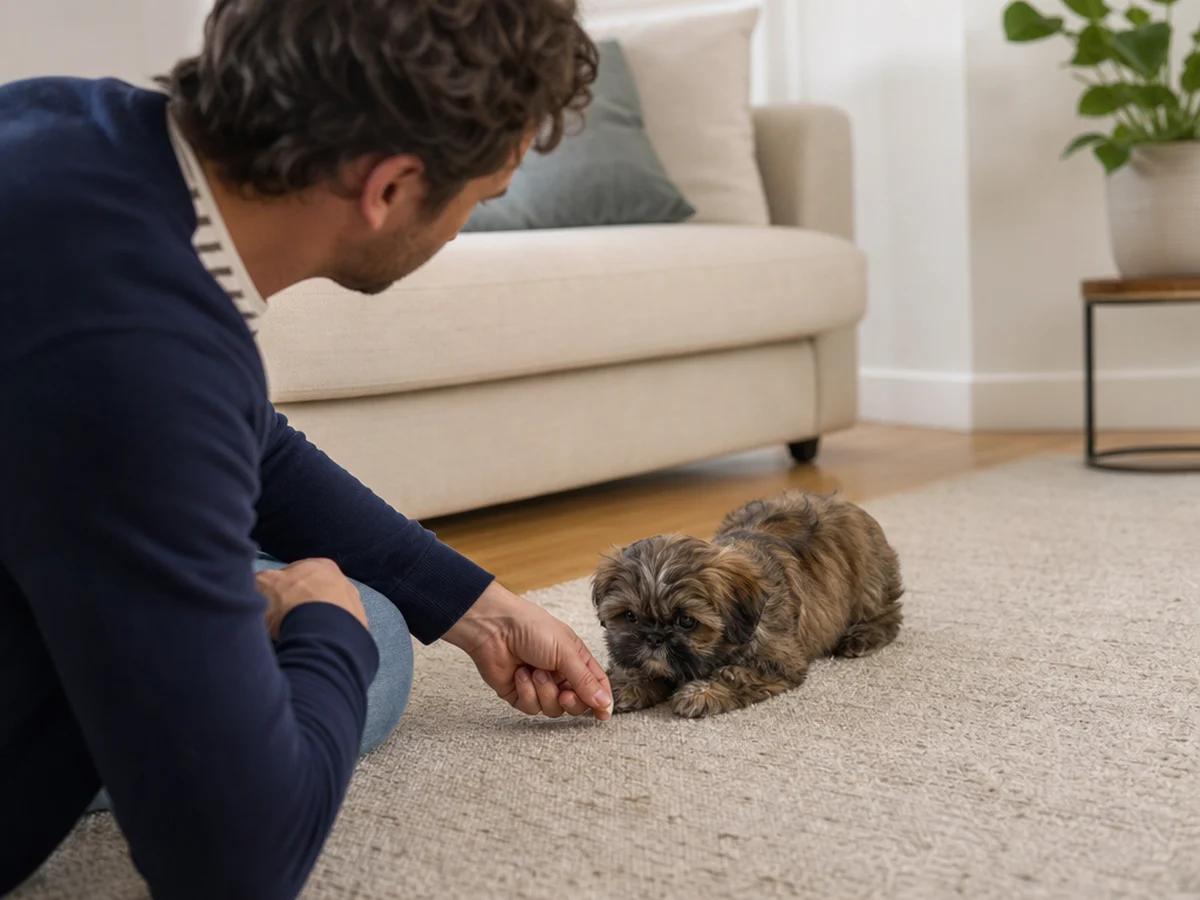
House-training comes first because it is the slow one. Shih Tzu are often considered hard to housebreak, and several weeks to months is normal, so don't measure yourself against a neighbor's dog. Prevention is the method: supervise, take your puppy out every two to three hours and after waking, meals and play, and reward every success.
Our potty training guide has the full schedule, and pee pad and litter box training shows the indoor options, which are legitimate for this breed.
Beyond potty trips, pick a handful of habits and let the rest wait:
- A potty routine with a treat and big praise every single time, plus a bell at the door so your puppy can learn to ask.
- Their name and a marker word, each followed by a treat, so paying attention becomes a habit.
- Calm handling of paws, face, ears and eyes, since owners who brushed and trimmed early describe dogs who sit still for it.
- Settling in the crate or pen with a chew, so time alone feels safe.
- Gated stairs, because puppies under six pounds learn to climb up before they can come down, so gates or playpens stay up until they manage safely.
That is the starter list, and nothing is lost by leaving everything else for later.
A Puppy Schedule for Months Three to Five
From about 12 weeks to five months, steadiness matters more than variety. Put eating, sleeping and playing on a clock and let training ride on top of it. Shih Tzu puppies sleep a great deal, so short sessions fit neatly between naps.
Shaping the Day
Teach one thing per session, use part of a meal as the reward, and stop while your puppy still wants more. Pair sessions with potty trips so the day feels like one smooth flow. Mouthing and chewing are common in these months, and teething runs to about 8 to 10 months (puppies vary), so keep chew items within reach. During teething some puppies eat less and some get pinched nostrils, so keep them calm and cool.
Expect wobbles, and try not to read them as failure. Owners describe good days and bad days around five months, with a puppy peeing minutes after coming inside, or accidents only in new places or when excited or scared. That is not a reset. It is a cue to supervise more closely for a while.
The Weekly Plan
Every day, run the potty rounds, a few short sessions rotating through the starter skills, and one calm handling moment. Midweek, add one new surface or sound, kept pleasant. On the weekend, plan an outing or a play date with a known, healthy dog. At week's end, look back: if accidents rose, return to the closer supervision that worked before, and run the same plan again.
Picking Puppy Classes and Outings
The best time to start socialization runs from 3 to 14 weeks, so by the time yours comes home that window is already narrowing. Ask what the breeder has introduced, then keep going. Puppies can generally start socialization classes at 7 to 8 weeks, once they have had a first vaccine at least 7 days earlier and a first deworming. Before about four months, one-on-one play dates with known, healthy dogs are a sensible bridge.
Size matters more than age. Choose a class where the dogs are all about the same size, because bigger dogs can be intimidating to a small puppy. Visit first without your puppy and check that the play is not so free-wheeling that a Shih Tzu gets overpowered. Good classes also give small puppies places to duck into, such as a tunnel set slightly off the wall.
Plan on a full program. Some club writers say an outgoing Shih Tzu needs very little, while others warn that starting late causes problems, and some puppies are fearless while others are skittish. Let your puppy's confidence set the pace. Add gradual outings with new people, noises and footing, always pleasant, and at the first signs of stress, stop and go back to something they handle confidently. The pick: one size-matched class plus gentle weekly outings.
Holding Steady Through Shih Tzu Puppy Adolescence
Around 7 to 8 months, many Shih Tzu enter an adolescence of about two months, and a sweet puppy can turn moody, stubborn and oddly forgetful. The real window is wider, since adolescence can start anywhere from six to 12 months and end between 18 and 24 months. That matches what owners report: dogs still jumpy at 8 months, and some only starting to calm down at about 1.5 to 2 years.
A breeder quoted by the AKC says the change is temporary, but also that adolescence is when rehoming is most likely, because people expect a puppy they can put back on the shelf. That is why these months are a critical time for reinforcing training. If you feel frazzled, you are in good company, and for most owners it does get better.
So go back a step, make cues easier, then pay well for them. Bring back closer supervision after any accidents and keep your rituals exactly the same. Some dogs are simply too excitable to learn tricks until after their first birthday, so build calm habits first. For the usual trouble spots, see common Shih Tzu behavior problems. The approach: lower the bar, reward generously, and let the routine carry you until the phase passes.
Shih Tzu Puppy Progress and When to Call a Pro
Progress with this breed looks quieter than you might expect. You are on track when your days feel calmer, your puppy answers to their name and cues faster, and accidents grow rarer, even with the occasional wobble. A puppy who settles in the crate, sits still for brushing and recovers quickly from a new noise is learning what you hoped, and the exact month matters far less.
Ask a professional for help if fearfulness is not easing, with a puppy who keeps shutting down despite gentle, gradual practice. Also ask if guarding of food, toys or people persists, or if progress stalls entirely despite a steady routine. A reward-based trainer who knows small breeds can spot what you miss. Regular vet visits belong in the plan too, and the main Shih Tzu training guide picks up where this timeline leaves off.
This is general information, not medical advice. A reliably trained dog who suddenly starts having accidents or going more often is a question for your veterinarian first, not a retraining job, so check with them.
Shih Tzu mature slowly and thrive on ritual, so the whole plan comes down to keeping the schedule, paying for what you like, and letting this charming, strong-willed little dog grow into the calm adult you are working toward.
 Exercise and jobsCan a Shih Tzu Be a Service Dog? Therapy and Support Roles
 Training basicsShih Tzu Temperament and Personality: What It Means for Training
 Training basicsAre Shih Tzus Smart? Training Them With the Right Reward